
CVE-2026-98432 Kernel Flaw: Ubuntu, RHEL, Debian Status
CVE-2026-98432 is a CVSS 9.8 Linux kernel TCP flaw. Fix status for Ubuntu, RHEL, Debian, Amazon Linux and SUSE, and how to prove each server is patched.
By PatchMon Team
Last updated: 30 October 2026. Distro status in this post was last checked against each vendor's own tracker at 00:10 UTC on 30 October 2026. Fixes are landing day by day, so we will keep the tables below current as Ubuntu and Red Hat ship.
A Linux kernel bug you can trigger with nothing more than TCP packets is rare. CVE-2026-98432 is one. It is a use-after-free in the IPv4 TCP handshake code, reachable by an unauthenticated peer before any application sees the connection, and the kernel's own CVE team scores it CVSS 9.8 Critical. On 27 October, Anthropic said one of its research models had turned it into a working remote root exploit against servers with a multipath TCP listener.
The upstream fix has been in the stable kernels since early October. The problem is the gap between upstream and your servers: Debian, SUSE, Oracle Linux and parts of Amazon Linux have shipped fixed kernels, while Ubuntu has not yet released one and Red Hat has deferred its fix. This post sets out where every major distro stands, what you can do in the meantime, and how to prove each host is actually running the fixed kernel rather than just having it on disk.
The Short Version
If you only have two minutes:
- What it is: A race condition use-after-free in
tcp_v4_syn_recv_sock()andip_options_build(), in the kernel's IPv4 TCP code. IPv4 only. - Severity: CVSS 3.1 9.8 from the kernel CVE team and Ubuntu. SUSE and Amazon score it 8.1. Red Hat scores it 5.9. Same bug, different assumptions (explained below).
- Who is affected: Every kernel from Linux 4.4 onwards until the fixed stable releases. That is effectively every supported distro.
- What an attacker needs: Network access to any listening TCP port over IPv4. No credentials, no user interaction.
- Fixed upstream in: 5.10.272, 5.15.223, 6.1.190, 6.6.159, 6.12.113, 6.18.56, 7.2.10 and 7.3.
- Ubuntu: Not fixed yet. Fixes are in progress for 22.04, 24.04, 26.04 and 26.10.
- RHEL, Rocky, AlmaLinux: Not fixed. Red Hat lists the fix as deferred.
- Debian, SUSE, Oracle Linux UEK: Fixed kernels are available now.
- What you do about it: Install the fixed kernel the moment your distro ships it, then reboot. A patched kernel on disk does nothing until the machine boots into it.
What CVE-2026-98432 Actually Is
The official CVE record, published by the Linux kernel CNA on 15 October 2026, describes the bug precisely. When a TCP connection completes its handshake, tcp_v4_syn_recv_sock() hands the IPv4 options saved from the client's SYN to the new child socket without copying them. Meanwhile, another CPU can be processing a retransmitted SYN for the same connection and building a SYNACK from those same options. If the child socket is torn down first, the options are freed with a plain kfree() while the SYNACK code is still reading them in ip_options_build().
That has been possible since commit 079096f103fa ("tcp/dccp: install syn_recv requests into ehash table"), which shipped in Linux 4.4, because request sockets stopped being processed under the listener lock.
There is a second, narrower path through request socket migration, which only applies if you have set net.ipv4.tcp_migrate_req=1 or loaded a BPF_SK_REUSEPORT_SELECT_OR_MIGRATE eBPF program.
The fix is small: free the options after an RCU grace period (kfree_rcu()), as other paths in the same code already did. IPv6 is not affected by the main bug, because tcp_v6_syn_recv_sock() copies the options. The IPv6 migration path has a similar issue limited to CALIPSO options, which the kernel developers say will be handled in a separate patch.
What an attacker gets
The kernel CNA's scoring rationale, published with the CVE, spells out all three impacts:
- Information disclosure: the stale options are copied into the SYNACK sent back to the attacker, which can leak kernel heap memory over the network.
- Memory corruption: reclaiming the freed object lets stale offsets steer writes in
ip_options_build(), which "permits out-of-bounds kernel writes and potential control-flow corruption." - Denial of service: a reclaimed length can drive
skb_push()past the packet headroom and hitskb_under_panic(), crashing the kernel.
The Anthropic exploit
On 27 October, Anthropic published research describing this bug as a "remotely triggerable (zero-click)" kernel flaw, found and exploited by an unreleased internal Claude model. Their proof of concept targeted Linux servers with a multipath TCP (MPTCP) listener: it used the race to leak a kernel pointer and defeat KASLR, then overwrote a callback pointer to run a shell command as root. A lost race just fails that one handshake, so the attacker can keep retrying. In their test it took 48 minutes to leak the pointer and another five to reach command execution.
Anthropic has not published the exploit. As of 30 October, the CVE is not in CISA's Known Exploited Vulnerabilities catalogue, and we have found no vendor reporting exploitation in the wild. That is a reason to patch calmly, not a reason to wait.
Why the Score Is 9.8 on Ubuntu but 5.9 on Red Hat
Your scanner may show this CVE as Critical on one host and Moderate on another. The vendors are scoring the same bug with different assumptions:
| Source | CVSS 3.1 | Vector |
|---|---|---|
| Linux kernel CNA | 9.8 Critical | AV:N/AC:L/PR:N/UI:N/S:U/C:H/I:H/A:H |
| Ubuntu | 9.8, priority High | Follows the CNA score |
| SUSE | 8.1 High (CVSS 4.0: 9.2) | AV:N/AC:H/PR:N/UI:N/S:U/C:H/I:H/A:H |
| Amazon Linux | 8.1 Important | AV:N/AC:H/PR:N/UI:N/S:U/C:H/I:H/A:H |
| Red Hat | 5.9 Moderate (draft) | AV:N/AC:H/PR:N/UI:N/S:U/C:N/I:N/A:H |
The two disagreements are:
- Attack complexity. The CNA rates it Low, arguing that both sides of the race are attacker-induced and that retrying is cheap. SUSE, Amazon and Red Hat rate it High because winning a cross-CPU race is not trivial.
- Impact. Red Hat treats denial of service as the practical worst case and scores confidentiality and integrity as None. Everyone else scores them High.
Anthropic's description of a working root exploit is hard to square with "availability only". Our advice is to treat this as remote code execution, whatever number your scanner prints.
Which Kernels Are Fixed Upstream
Per the CVE record, these stable releases contain the fix:
| Stable branch | First fixed release |
|---|---|
| 5.10 | 5.10.272 |
| 5.15 | 5.15.223 |
| 6.1 | 6.1.190 |
| 6.6 | 6.6.159 |
| 6.12 | 6.12.113 |
| 6.18 | 6.18.56 |
| 7.2 | 7.2.10 |
| Mainline | 7.3 |
This table only helps if you build your own kernels or run a distro that tracks upstream stable closely. Distribution kernels backport fixes onto their own version numbers. Ubuntu 24.04's 6.8.0 kernel, for example, is not an upstream stable branch at all, so a version comparison against this table tells you nothing about it. You need your distro's advisory.
What Your Distro Is Shipping
Checked against each vendor's own tracker on 30 October 2026.
| Distribution | Status | Fixed kernel or advisory |
|---|---|---|
| Ubuntu 26.10, 26.04 LTS, 24.04 LTS, 22.04 LTS | Vulnerable, fix in progress | Not yet released |
| Ubuntu 20.04, 18.04, 16.04 | Vulnerable | None announced |
| RHEL 8, 9, 10 (incl. kernel-rt) | Fix deferred | None |
| OpenShift 4 (RHEL CoreOS) | Fix deferred | None |
| RHEL 7 | Not affected | n/a |
| Debian 13 "trixie" | Fixed | linux 6.12.113-1 (DSA-6568-1) |
| Debian 12 "bookworm" | Fixed | linux 6.1.190-1 (DLA-4841-1), linux-6.12 6.12.113-1~deb12u1 (DLA-4850-1) |
Amazon Linux 2023, kernel6.18 |
Fixed 24 Oct | ALAS2023-2026-3251 |
Amazon Linux 2023, kernel6.12 |
Fixed 29 Oct | ALAS2023-2026-3335 |
Amazon Linux 2023 default kernel; Amazon Linux 2 |
Pending fix | None |
| SLES 16.0, openSUSE Leap 16.0, SL Micro 6.2 | Fixed | kernel-default 6.12.0-160000.40.1 |
| SLES 15 SP6-LTSS | Fixed | kernel-default 6.4.0-150600.23.143.1 |
| SLES 15 SP5-LTSS, SLE Micro 5.5 | Fixed | kernel-default 5.14.21-150500.55.195.1 |
| SLES 15 SP4-LTSS, SLE Micro 5.3/5.4 | Fixed | kernel-default 5.14.21-150400.24.246.1 |
| SLES 15 SP7 | In progress | None |
| Oracle Linux 7 to 10 (UEK) | Fixed 16 Oct | ELSA-2026-500397, ELSA-2026-500398, ELSA-2026-500399 |
Ubuntu
Ubuntu's CVE page rates CVE-2026-98432 at priority High and lists every supported kernel as Vulnerable. Fixes are marked "work in progress" in these versions, which tells you what to look for once they are released:
| Kernel package | 26.10 | 26.04 LTS | 24.04 LTS | 22.04 LTS |
|---|---|---|---|---|
linux (generic) |
7.3.0-10.10 | 7.0.0-43.43 | 6.8.0-149.149 | 5.15.0-203.213 |
linux-aws |
7.3.0-1004.4 | 7.0.0-1017.18 | 6.8.0-1069.74 | 5.15.0-1120.127 |
linux-azure |
7.3.0-1004.4 | 7.0.0-1020.21 | 6.8.0-1073.82 | 5.15.0-1126.135 |
linux-gcp |
7.3.0-1004.4 | 7.0.0-1017.19 | in progress | 5.15.0-1121.131 |
linux-oracle |
7.3.0-1004.4 | 7.0.0-1016.18 | 6.8.0-1067.71 | 5.15.0-1117.123 |
These are not released packages yet. Until Ubuntu marks them Released, apt upgrade will not give you a fixed kernel. Ubuntu 20.04, 18.04 and 16.04 show plain Vulnerable with no fix version, so if you still run them under Ubuntu Pro or ESM, watch the same page.
RHEL, Rocky Linux and AlmaLinux
Red Hat lists RHEL 8, 9 and 10, including the real-time kernels and OpenShift's CoreOS nodes, as Fix deferred, and states that no mitigation meets its criteria. RHEL 7 is not affected. Rocky Linux and AlmaLinux rebuild RHEL, so check their errata once Red Hat ships rather than assuming the date. If you run an ELRepo or other mainline kernel on these systems, compare it with the upstream table above instead.
Debian
Debian's tracker shows fixed kernels in the security archive for trixie (6.12.113-1) and bookworm (6.1.190-1, plus 6.12.113-1~deb12u1 for the backported 6.12 kernel). The kernels in the main bookworm and trixie suites are still the vulnerable ones, so make sure security.debian.org is in your sources.
Amazon Linux
On Amazon Linux 2023, only the optional kernel6.18 and kernel6.12 packages are fixed so far. The default kernel package and every Amazon Linux 2 kernel are still Pending Fix.
SUSE and openSUSE
SUSE has released fixed kernels for SLES 16.0, the 15 SP4 to SP6 LTSS streams and several SLE Micro releases. SLES 15 SP7 is still in progress, and SLE Micro 6.0 and 6.1 are listed as affected.
Oracle Linux
Oracle released fixed Unbreakable Enterprise Kernel errata for Oracle Linux 7 to 10 on 16 October, before most other vendors. Hosts running the Red Hat Compatible Kernel instead of UEK should follow Oracle's errata for that kernel separately.
If You Cannot Patch Right Now
For most Ubuntu and RHEL-family hosts, "patch now" is not yet an option. Here is what you can do in the meantime. None of it replaces the kernel update.
Keep request migration off. The secondary path needs tcp_migrate_req enabled, and it is off by default. Confirm it:
sysctl net.ipv4.tcp_migrate_req # should print 0
This closes only the migration path, not the main bug.
Find your MPTCP listeners. The published exploit targeted servers with a multipath TCP listener, and you may have more than you think: since Go 1.24, net.ListenConfig "uses MPTCP by default on systems where it is supported (currently on Linux only)". To list MPTCP sockets on a host:
ss -Mlnp
Anthropic has not said whether servers without MPTCP are exploitable for root, and the bug itself is in the plain IPv4 TCP path. Treat removing MPTCP as reducing exposure, not closing it.
Filter IPv4 Record Route options at the edge. The trigger relies on a SYN carrying IPv4 Record Route or Timestamp options, which almost no legitimate traffic uses. With nftables you can drop Record Route:
nft add rule inet filter input ip option rr exists drop
(Adjust the table and chain names to your ruleset.) We tested that this rule is accepted by nftables 1.0.9 on Ubuntu 24.04. That version cannot match the Timestamp option, so this blocks only part of the trigger. No vendor has confirmed edge filtering as a mitigation. Treat it as defence in depth, and test it before you roll it out.
Watch for crashes. A failed or noisy exploitation attempt can oops the kernel. Look for the functions named in the CVE:
journalctl -k | grep -E 'ip_options_build|ip_build_and_send_pkt|skb_under_panic'
Prioritise by exposure. Internet-facing hosts with open TCP ports over IPv4 come first, then anything running Go services or MPTCP, then internal hosts.
How to Tell Your Fleet Is Actually Patched
Kernel CVEs have the same trap every time, as we saw with Copy Fail: a fixed kernel package installed is not a fixed kernel running. Three things go wrong:
- The kernel updated and nobody rebooted. The new kernel sits in
/bootwhile the old one keeps serving traffic. - A host runs a kernel flavour you did not check. An
-awsor-azurekernel on Ubuntu,kernel6.12on Amazon Linux, UEK versus RHCK on Oracle Linux. Each has its own fix status. - The version string tells you nothing on its own.
6.8.0-149only means something next to Ubuntu's advisory, and a backported RHEL kernel never matches an upstream version.
On a single host, check the running kernel and then confirm the fix in its changelog. Most distro kernel changelogs reference the CVE ID:
# What is actually running
uname -r

# Debian / Ubuntu
apt changelog linux-image-$(uname -r) 2>/dev/null | grep CVE-2026-98432
[ -f /var/run/reboot-required ] && echo "Reboot required"

# RHEL / Rocky / Alma / Oracle / Amazon Linux
rpm -q --changelog kernel-$(uname -r) | grep CVE-2026-98432
needs-restarting -r

# SUSE
rpm -q --changelog kernel-default | grep CVE-2026-98432
On one server that takes a minute. Across two hundred, with Ubuntu and Red Hat fixes still to land over the coming days, the real job is keeping one list current.
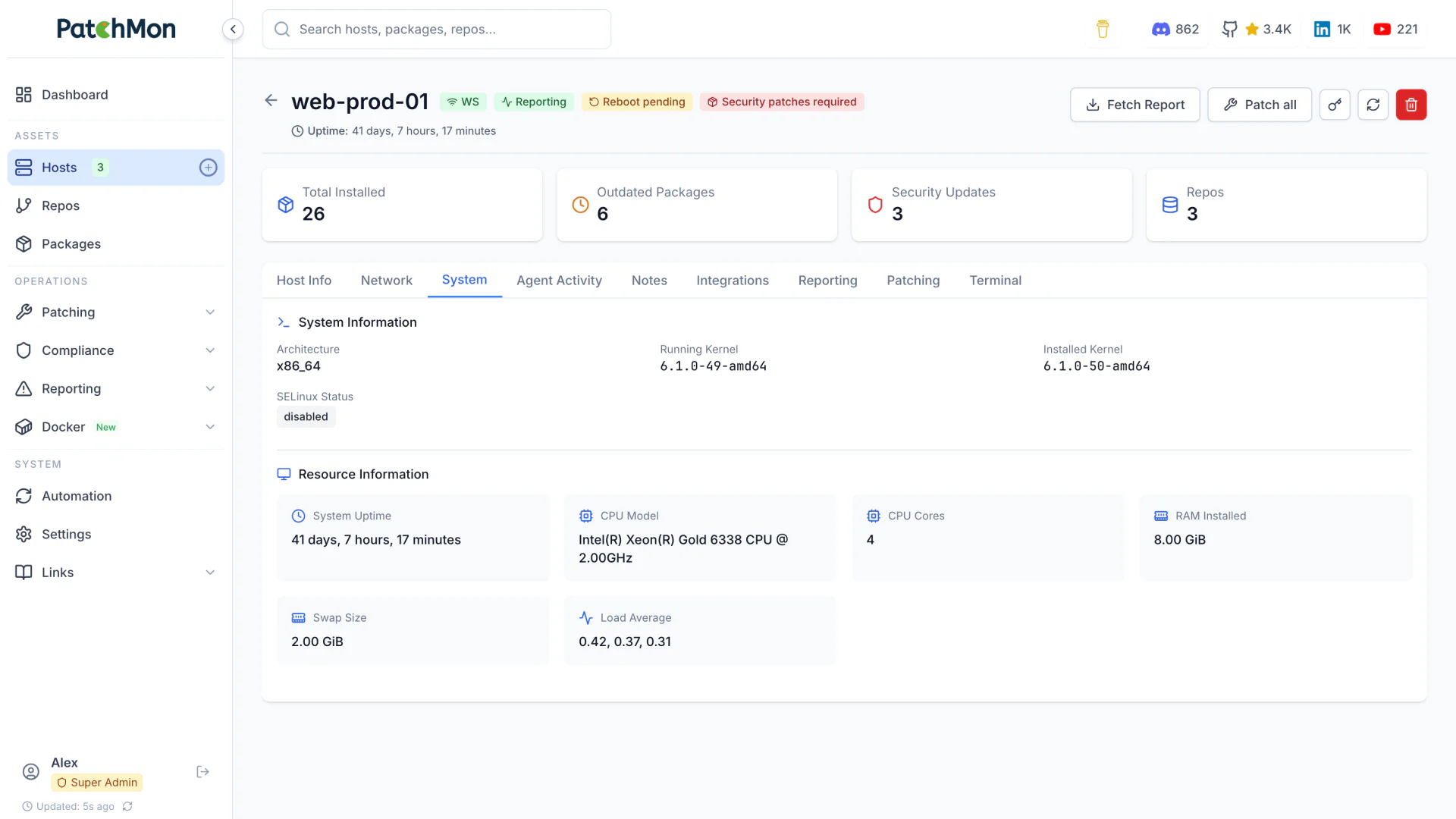
This is the problem PatchMon is built for. Every host page shows the running kernel and the installed kernel side by side, and hosts that have installed a new kernel without booting into it get a Reboot pending flag. The agent reports every installed package and the updates available for it, including whether an update is a security update. When Ubuntu and Red Hat ship their fixed kernels, they show up as pending security updates across the affected hosts; as each host updates, reboots and reports back, it drops off the list. That gives you one answer to "which servers are still running a vulnerable kernel?" instead of an afternoon of SSH, and a timestamped record for your auditor afterwards.
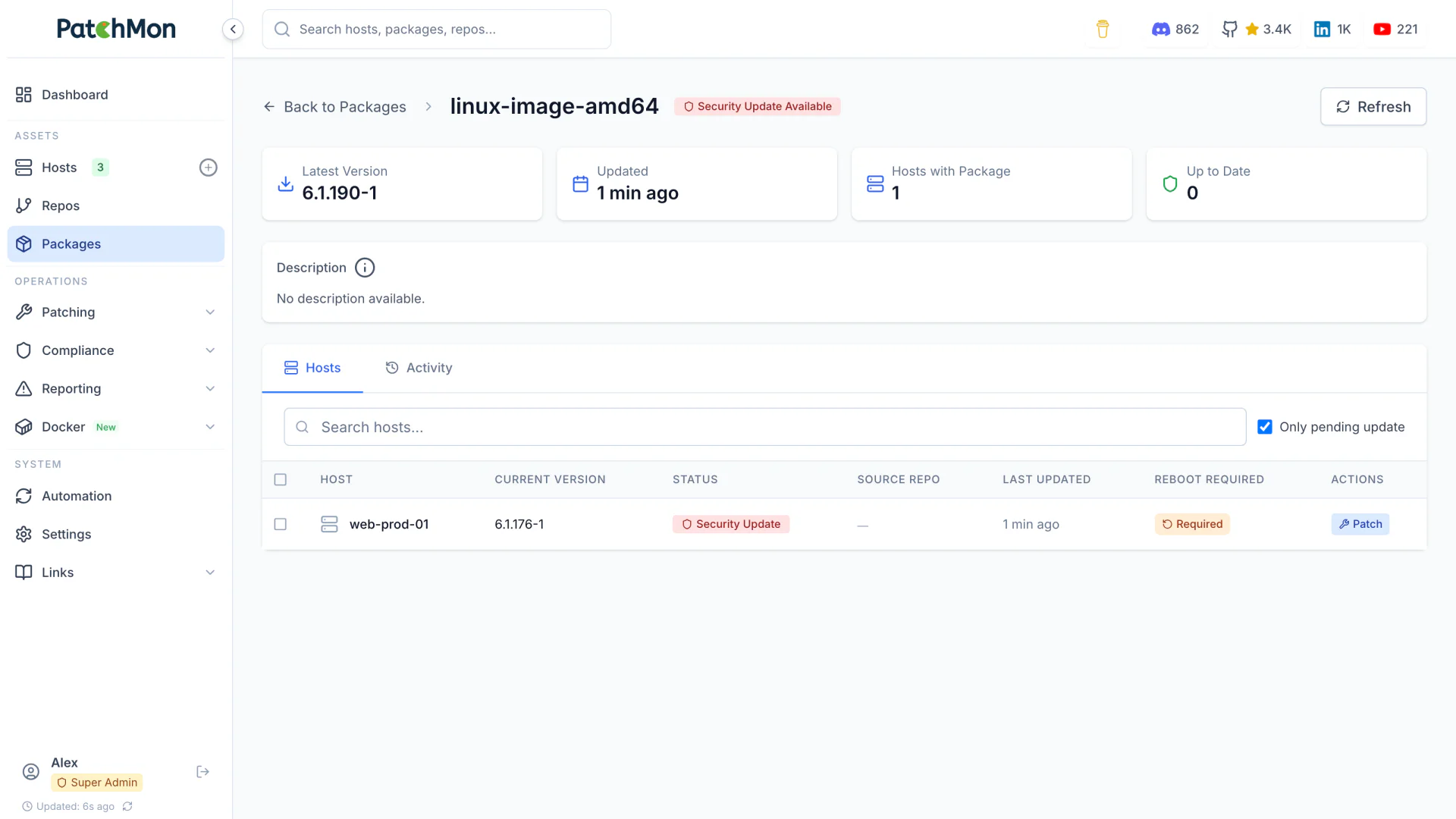
The linux-image-amd64 package across the fleet: which hosts have the 6.1.190-1 security update waiting, and which need a reboot. Demo data.
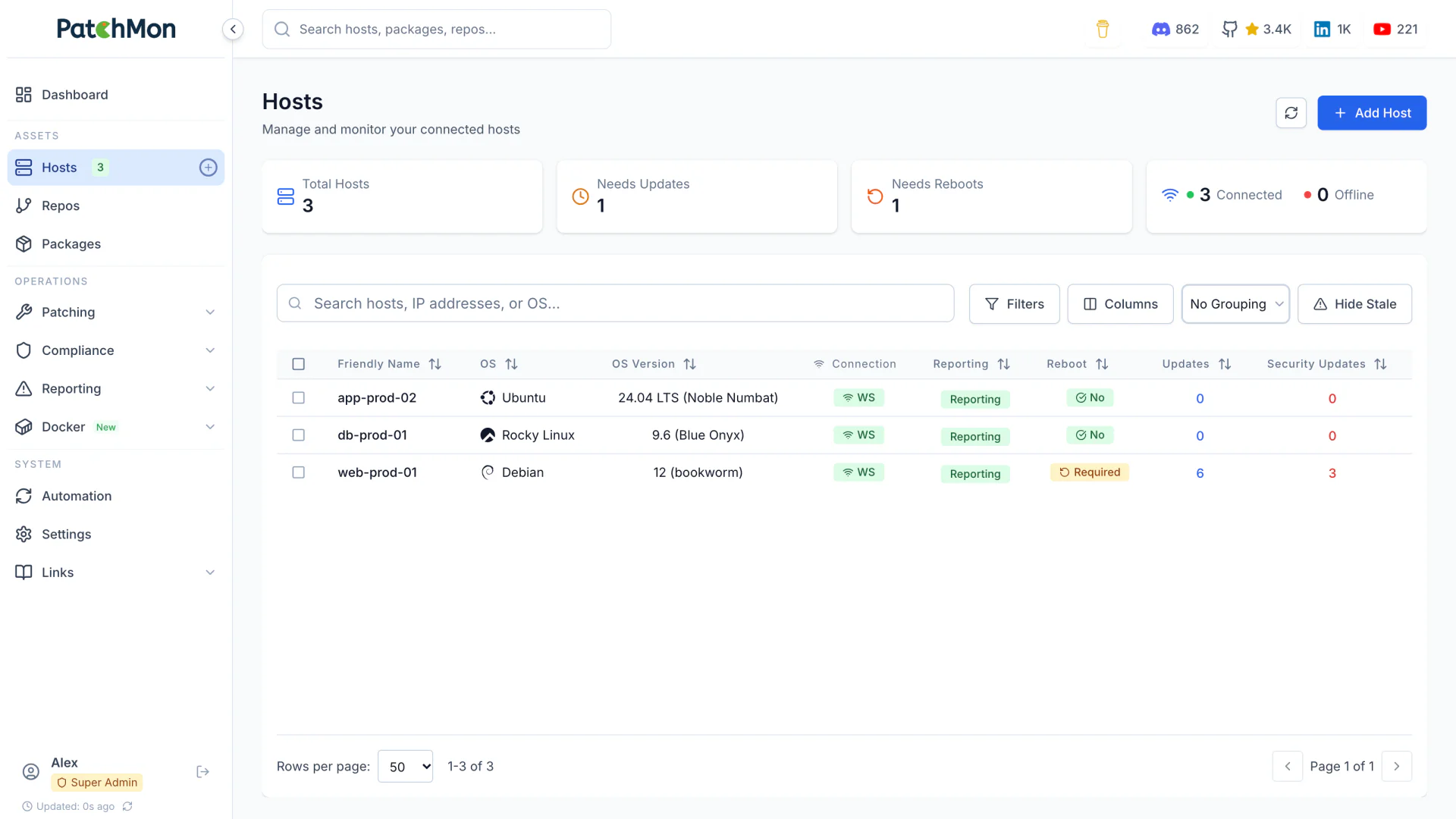
The hosts list answers the fleet question directly: how many hosts need updates, and how many need a reboot. Demo data.
If you would like to see that against your own servers, have a look at the PatchMon pricing page and start a PatchMon Cloud trial from there; it takes a few minutes to get the first agents reporting. If you would rather self-host, the Community Edition is free and open source.
Frequently Asked Questions
Is Ubuntu 24.04 patched for CVE-2026-98432?
Not as of 30 October 2026. Ubuntu lists the linux package for 24.04 as Vulnerable, with a fix in progress in 6.8.0-149.149. Check Ubuntu's CVE page for the Released status.
Is Ubuntu 22.04 patched? Not yet. The fix is in progress in 5.15.0-203.213 for the generic kernel.
Does RHEL, Rocky Linux or AlmaLinux have a fix? No. Red Hat lists the fix for RHEL 8, 9 and 10 as deferred, and Rocky and AlmaLinux rebuild from RHEL. RHEL 7 is not affected.
Which Debian kernel fixes CVE-2026-98432? 6.12.113-1 on Debian 13 trixie, and 6.1.190-1 (or 6.12.113-1~deb12u1) on Debian 12 bookworm, from the security archive.
Is IPv6 affected? The main bug is IPv4 only. An IPv6 variant exists only on the migration path and only with CALIPSO options.
Do I need to reboot? Yes, unless a livepatch for this specific CVE has been applied. Check with your livepatch provider whether one is available.
Is it being exploited in the wild? No vendor or CERT has reported in-the-wild exploitation, and it is not in CISA KEV as of 30 October 2026. A working exploit has been described by Anthropic but not published.
Bottom Line
CVE-2026-98432 is a remotely reachable kernel memory-corruption bug in code every Linux server runs, with a credible root exploit already described. The fix exists upstream and on Debian, SUSE and Oracle Linux. Ubuntu and Red Hat users are still waiting.
What to do today:
- Inventory your kernels now: distro, flavour and running version on every host.
- Patch and reboot wherever a fix exists: Debian, SUSE, Oracle UEK and the Amazon Linux 2023
kernel6.xpackages. - For Ubuntu and RHEL-family hosts, reduce exposure while you wait: keep
tcp_migrate_reqat 0, find MPTCP listeners, and consider edge filtering of IPv4 options. - Install and reboot the moment Ubuntu and Red Hat release, then verify the running kernel, not the installed one.
The teams that get through events like this calmly are the ones who can answer "which hosts are still running the vulnerable kernel?" in minutes. If you want to see how PatchMon does that, the pricing page is the place to start a trial. Either way, get those reboots scheduled.
Sources and Further Reading
- CVE.org: CVE-2026-98432
- Upstream fix commit e3f33b0a1d89
- Ubuntu: CVE-2026-98432
- Red Hat: CVE-2026-98432
- Debian security tracker: CVE-2026-98432
- Amazon Linux: CVE-2026-98432
- SUSE: CVE-2026-98432
- Oracle Linux: CVE-2026-98432
- Anthropic: Discovering vulnerabilities with Claude
- Go 1.24 release notes (MPTCP default)
- Linux kernel docs: IP sysctl
- Linux kernel docs: MPTCP
- CISA Known Exploited Vulnerabilities catalogue